

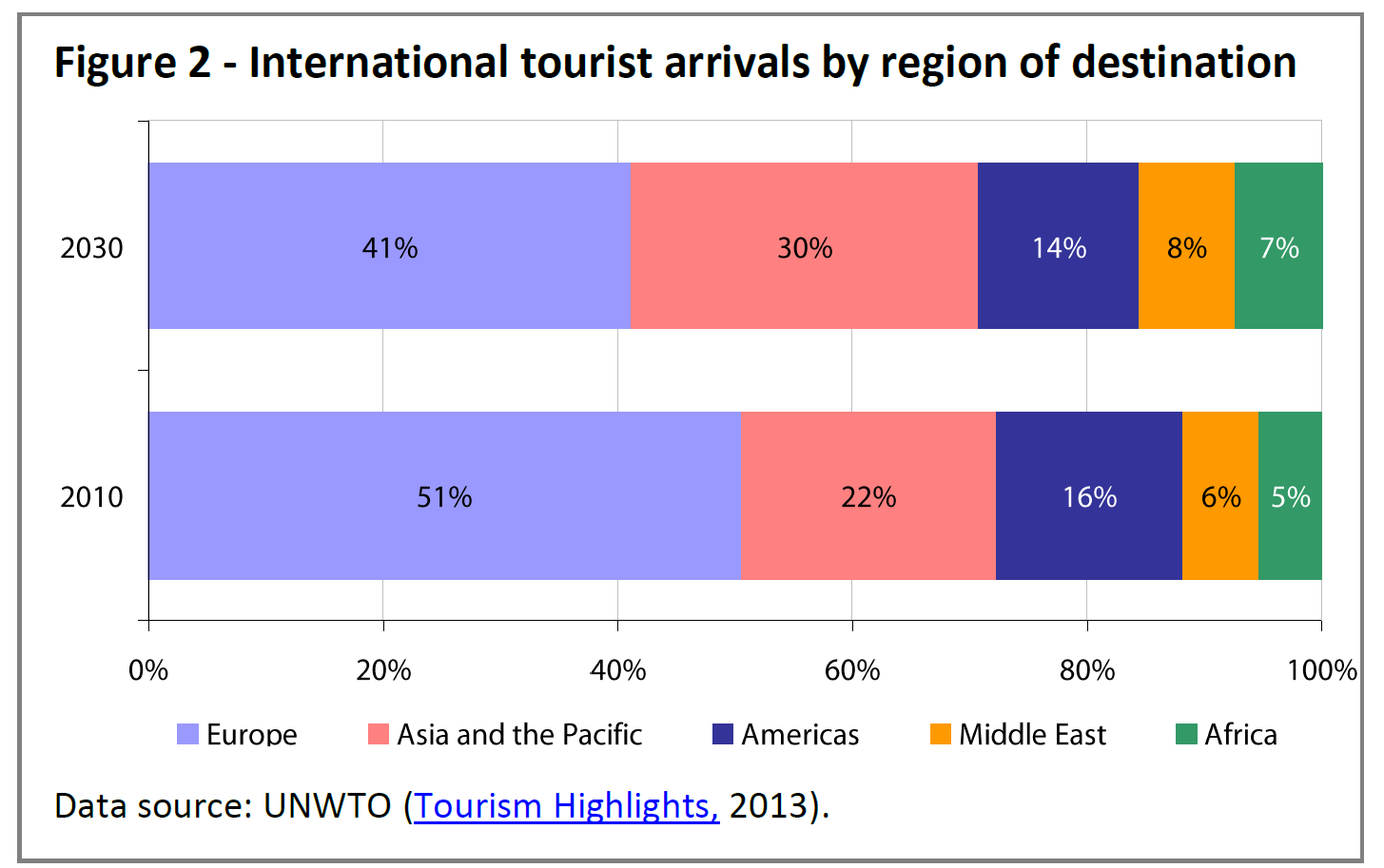
The market share of emerging economies in terms of Tourism and the EU international tourist arrivals increased from 30% in 1980 to 47% in 2012 and is foreseen to reach 57% by 2030. As figure 2 shows, Europe’s market share is expected to decrease by 2030 while, in parallel, the weight of Asia and the Pacific is expected to grow.






The market share of emerging economies in terms of Tourism and the EU international tourist arrivals increased from 30% in 1980 to 47% in 2012 and is foreseen to reach 57% by 2030. As figure 2 shows, Europe’s market share is expected to decrease by 2030 while, in parallel, the weight of Asia and the Pacific is expected to grow.
The market share of emerging economies in terms of Tourism and the EU international tourist arrivals increased from 30% in 1980 to 47% in 2012 and is foreseen to reach 57% by 2030. As figure 2 shows, Europe’s market share is expected to decrease by 2030 while, in parallel, the weight of Asia and the Pacific is expected to grow.
The market share of emerging economies in terms of Tourism and the EU international tourist arrivals increased from 30% in 1980 to 47% in 2012 and is foreseen to reach 57% by 2030. As figure 2 shows, Europe’s market share is expected to decrease by 2030 while, in parallel, the weight of Asia and the Pacific is expected to grow.
The market share of emerging economies in terms of Tourism and the EU international tourist arrivals increased from 30% in 1980 to 47% in 2012 and is foreseen to reach 57% by 2030. As figure 2 shows, Europe’s market share is expected to decrease by 2030 while, in parallel, the weight of Asia and the Pacific is expected to grow.
The market share of emerging economies in terms of Tourism and the EU international tourist arrivals increased from 30% in 1980 to 47% in 2012 and is foreseen to reach 57% by 2030. As figure 2 shows, Europe’s market share is expected to decrease by 2030 while, in parallel, the weight of Asia and the Pacific is expected to grow.
The market share of emerging economies in terms of Tourism and the EU international tourist arrivals increased from 30% in 1980 to 47% in 2012 and is foreseen to reach 57% by 2030. As figure 2 shows, Europe’s market share is expected to decrease by 2030 while, in parallel, the weight of Asia and the Pacific is expected to grow.
International tourist arrivals have risen from 278 million
In 1980 to 1035 million in 2012 and are expected to grown by 3.3% a year on average from now to 2030.Europe remains the world’s number one tourist destination, accounting for half of all international tourist arrivals worldwide.
The market share of emerging economies in terms of Tourism and the EU international tourist arrivals increased from 30% in 1980 to 47% in 2012 and is foreseen to reach 57% by 2030. As figure 2 shows, Europe’s market share is expected to decrease by 2030 while, in parallel, the weight of Asia and the Pacific is expected to grow.
yes i agree
The market share of emerging economies in terms of Tourism and the EU international tourist arrivals increased from 30% in 1980 to 47% in 2012 and is foreseen to reach 57% by 2030. As figure 2 shows, Europe’s market share is expected to decrease by 2030 while, in parallel, the weight of Asia and the Pacific is expected to grow.
The market share of emerging economies in terms of Tourism and the EU international tourist arrivals increased from 30% in 1980 to 47% in 2012 and is foreseen to reach 57% by 2030. As figure 2 shows, Europe’s market share is expected to decrease by 2030 while, in parallel, the weight of Asia and the Pacific is expected to grow.
The market share of emerging economies in terms of Tourism and the EU international tourist arrivals increased from 30% in 1980 to 47% in 2012 and is foreseen to reach 57% by 2030. As figure 2 shows, Europe’s market share is expected to decrease by 2030 while, in parallel, the weight of Asia and the Pacific is expected to grow.