
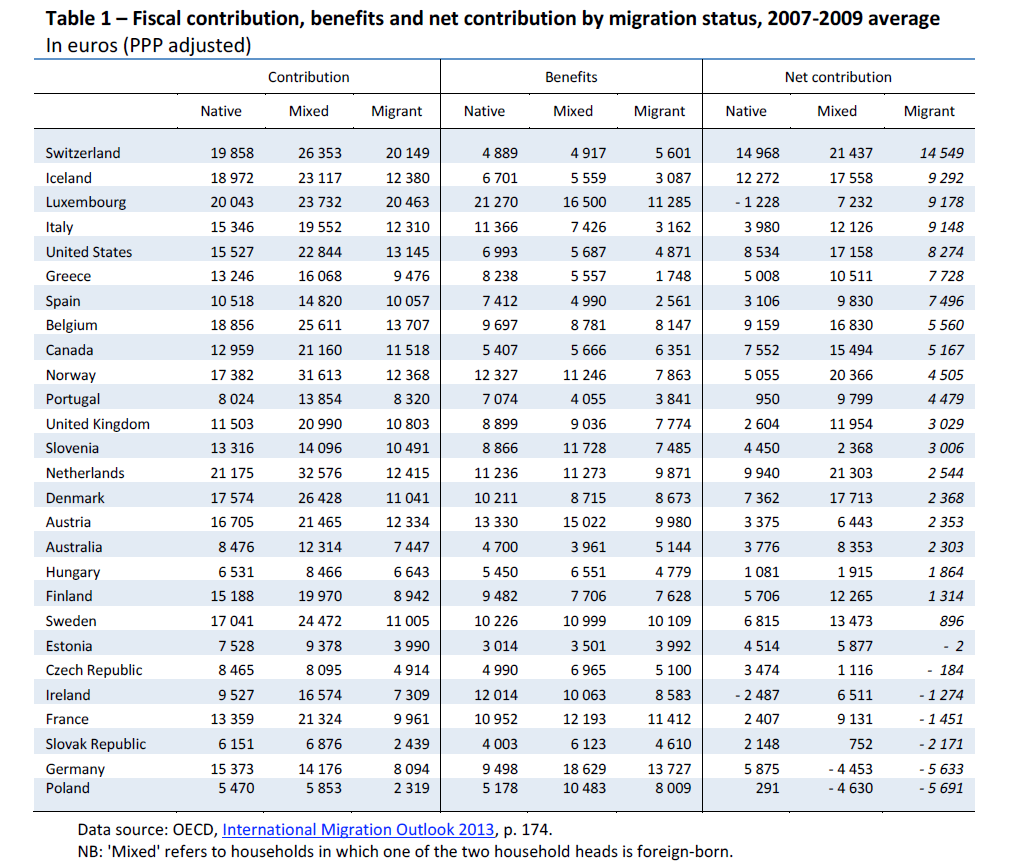
The ‘International Migration Outlook 2013’ report of the OECD looks, inter alia, at the fiscal impact of migration for European OECD countries and for Australia, Canada and the United States. The study suggests that the impact of the cumulative waves of migration (that have arrived over the past 50 years in OECD countries) is on average close to zero, rarely exceeding 0.5% of GDP in either positive or negative terms. The impact is highest in Switzerland and Luxembourg, where immigrants provide an estimated net benefit of about 2% of GDP to the public purse. It seems that some countries are more successful than others in integrating immigrants into their labour markets. While in the UK, for instance, proportionately only slightly more immigrants are unemployed than natives, in Spain, Greece, Belgium and Sweden there is a gap of 10 percentage points or more.

Fiscal contribution, benefits and net contribution by migration status, 2007-2009 average
Visit the European Parliament page on
We write about
RSS Link to Scientific Foresight (STOA)
RSS Link to Members’ Research Service
Blogroll
Disclaimer and Copyright statement
The content of all documents (and articles) contained in this blog is the sole responsibility of the author and any opinions expressed therein do not necessarily represent the official position of the European Parliament. It is addressed to the Members and staff of the EP for their parliamentary work. Reproduction and translation for non-commercial purposes are authorised, provided the source is acknowledged and the European Parliament is given prior notice and sent a copy.
For a comprehensive description of our cookie and data protection policies, please visit Terms and Conditions page.
Copyright © European Union, 2014-2019. All rights reserved.


Be the first to write a comment.