

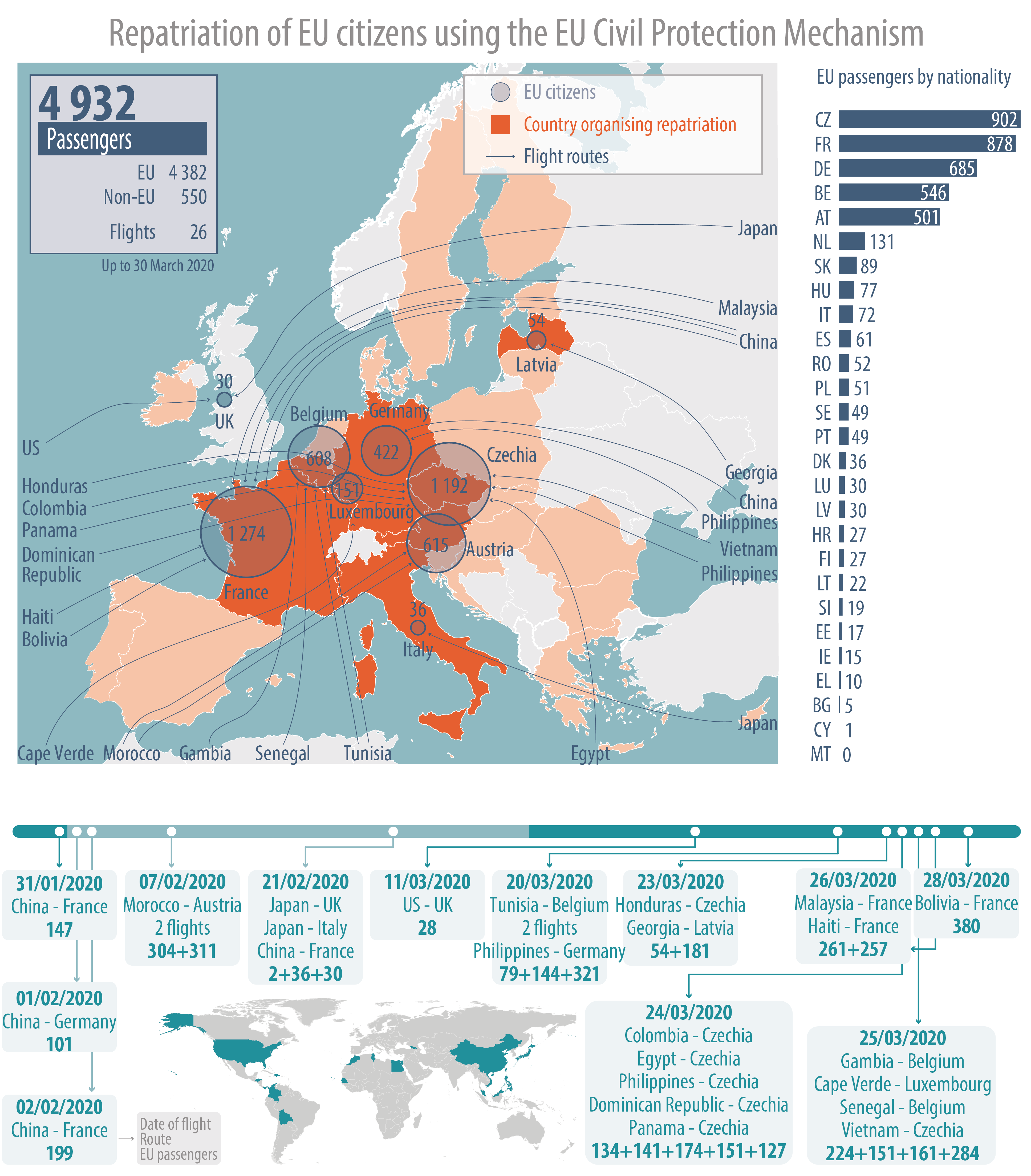
When the return of citizens is no longer possible in this manner, which has increasingly been the case, there are grounds for more EU resources to be activated in order to facilitate the safe return of everybody who needs help. The situation is assessed by the Emergency Response Coordination Centre, together with the European External Action Service and EU Member States. If they determine that the situation requires special assets and assistance, EU Member States may then activate the EU Civil Protection Mechanism. In this manner, 4 382 EU citizens had been repatriated up to 30 March, first from China, and subsequently from a wide range of countries, including Cape Verde, the Dominican Republic, Egypt, Georgia, Japan, Morocco, the Philippines, Tunisia, the USA and Vietnam (see Figure 1). The Mechanism was first activated for the repatriation of EU citizens following a request for assistance by France to provide consular support to EU citizens in Wuhan, China, the epicentre of the outbreak. On this occasion, Janez Lenarčič, Commissioner for Crisis Management, gave an assurance that the EU would not forget its citizens in need, wherever they are in the world. As a result, two planes were sent initially by France to retrieve healthy and asymptomatic EU citizens. Further planes were later sent to China, an additional one by France and one by Germany. The 95 EU citizens who were retrieved by a UK repatriation flight to the UK were also returned to their respective Member States. This last leg of their journey was co-funded by the Civil Protection Mechanism.






Be the first to write a comment.